



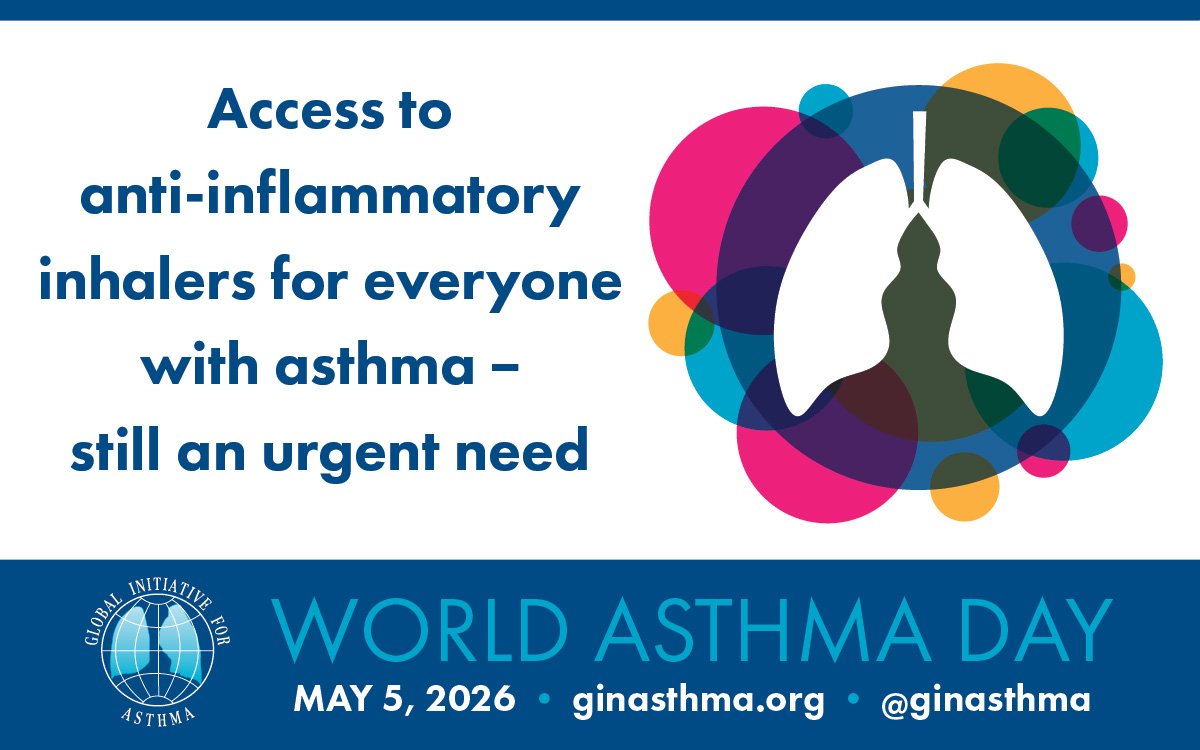
The World Health Organization designates the first Tuesday of May each year as World Asthma Day. On May 5, 2026, we will mark the 28th World Asthma Day, with the theme: "Ensuring access to anti‑inflammatory inhalers for every person with asthma – still a priority" (Source: GINA official website).
Concurrently, the Chinese Medical Association, its General Practice branch, the Asthma Group of the Respiratory Disease branch, and other leading institutions have jointly released the Chinese General Practice Guidelines for the Diagnosis and Management of Bronchial Asthma (2026) – providing the latest authoritative framework for asthma control in China.
Asthma is a common and burdensome respiratory disease. In China, there are an estimated 45.7 million asthma patients aged 20 years and older, of whom 55‑70% have poorly controlled disease, putting them at high risk for acute exacerbations. During the spring‑summer transition, airborne catkins from trees across many regions, combined with large day‑night temperature differences, cause a surge in respiratory clinic visits. Cough‑variant asthma (CVA), characterized by chronic dry cough without typical wheezing, often lingers and eventually leads to breathing difficulties that severely impact patients’ daily lives.
Among asthma drug development, nebulized therapy has become a cornerstone for both clinical treatment and preclinical evaluation, owing to its precise airway targeting. The core mechanism lies in converting anti‑inflammatory and bronchodilator candidates into fine aerosol particles (1‑10 μm, matching airway deposition characteristics) using nebulizers, delivering them directly to the upper and lower respiratory tract target organs. This directly acts on inflamed airway mucosa – reducing eosinophil and macrophage infiltration, lowering inflammatory cytokine release, alleviating mucosal congestion, edema, and mucus hypersecretion – thereby tackling airway narrowing at its source. Meanwhile, nebulized administration rapidly relaxes airway smooth muscle and relieves bronchospasm, improving ventilation and alleviating dyspnea, paroxysmal cough, wheeze, and chest tightness. In preclinical inhalation research, nebulized delivery is not only a key therapeutic modality but also the core vehicle for evaluating candidate inhaled drugs (e.g., corticosteroids, β2‑agonists) for efficacy, safety, and dosing regimens. Through nebulization, researchers precisely assess airway deposition efficiency, anti‑inflammatory and spasmolytic effects, and potential airway toxicity – generating reliable non‑clinical data that support subsequent clinical studies and validate therapeutic value and feasibility.
On World Asthma Day 2026, we focus on three “golden pillars” of preclinical research: efficacy, pharmacokinetics (PK), and toxicology.
Every safe, effective asthma nebulized drug must undergo rigorous preclinical evaluation before reaching patients. As a compass for novel drug R&D, InnoStar has dedicated years of expertise to inhaled formulation evaluation. Backed by an international GLP certification system and AAALAC international animal welfare accreditation, InnoStar concentrates on efficacy, PK, and toxicology – building a robust safety shield for asthma nebulized drug development, accelerating the journey from lab to clinic, and benefiting more patients.
Preclinical Efficacy – Seeing Efficacy in Surrogate Models
Using a well‑defined inhaled drug candidate as an example, preclinical efficacy evaluation follows the principle of “in‑vivo and in‑vitro cross‑validation.” InnoStar’s inhalation platform is equipped with high‑precision nose‑only inhalation exposure systems, establishing a wide array of animal models including airway inflammation, asthma, lung injury, pulmonary fibrosis, and bacterial/viral lung infections, to precisely evaluate anti‑inflammatory, spasmolytic, and airway‑protective effects. Multidimensional endpoints – pulmonary function tests, BALF cytokine analysis, and lung histopathology – comprehensively validate the mechanism of action. For one inhaled corticosteroid, InnoStar’s team demonstrated in an OVA mouse model that after nebulization, IL‑5 (a key eosinophil activator) levels in BALF dropped markedly, and lung inflammatory infiltration was significantly alleviated – a snapshot of modern pharmacological evaluation through precise models and rigorous exposure methods that simulate the drug’s action pathway in humans.
Preclinical Pharmacokinetics – Unlocking the Optimal Targeted Delivery Route
Given the unique aspects of nebulized inhalation, InnoStar’s PK team focuses on airway deposition efficiency, absorption rate, intrapulmonary retention time, and metabolic excretion patterns. By simulating clinical nebulization scenarios, controlling aerosol particle size to 2‑5 μm (aligned with asthma treatment airway deposition requirements), and precisely measuring drug concentrations in lung tissue and plasma, we optimize formulation and dosing parameters. This improves bioavailability, bypasses hepatic first‑pass metabolism loss, ensures effective drug concentrations at airway target sites, and minimizes systemic exposure – achieving precise, rapid onset of action.
Preclinical Toxicology – Guarding the Safety Bottom Line
Under GLP compliance, InnoStar’s toxicology platform comprehensively evaluates potential toxicity of nebulized drugs – with special emphasis on airway local toxicity (e.g., mucosal irritation, epithelial injury), systemic toxicity, and long‑term safety, establishing the no‑observed‑adverse‑effect level (NOAEL). We go beyond routine liver/kidney function assessments to include meticulous histopathological examination of the entire respiratory tract (nose, pharynx, larynx, trachea, lungs). In repeat‑dose studies, we assess impacts on airway barrier integrity, identify risks such as inflammation or cellular injury, and verify safety for systemic organs (liver, kidneys, etc.). These findings provide scientific support for clinical dose setting, preventing unsafe drugs from reaching patients and safeguarding medication safety.
Starting from World Asthma Day, we stand at a pivotal moment in evaluation paradigm shifts. GINA emphasizes ensuring “inhaler for everyone” in asthma care. That is precisely InnoStar’s mission: to advance preclinical research with professional dedication, to empower nebulized drug development with scientific rigor, to tackle pain points in asthma therapeutics, and to help bring more high‑quality nebulized drugs to market – ensuring smooth breathing for asthma patients worldwide.
InnoStar – making every inhalation safe and secure.
Address: 199 Guoshoujing Road, Pilot Free Trade Zone, Shanghai, China
Postcode: 201203
Tel: +86-21-60211999
services@innostarbio.com
86-021-xxxxxxx

Scan the QR code
Subscription to our Wechat account
Copyright © 2017-2021©Shanghai InnoStar Bio-tech Co., Ltd. All Rights Reserved. Created By VPABrand.com